
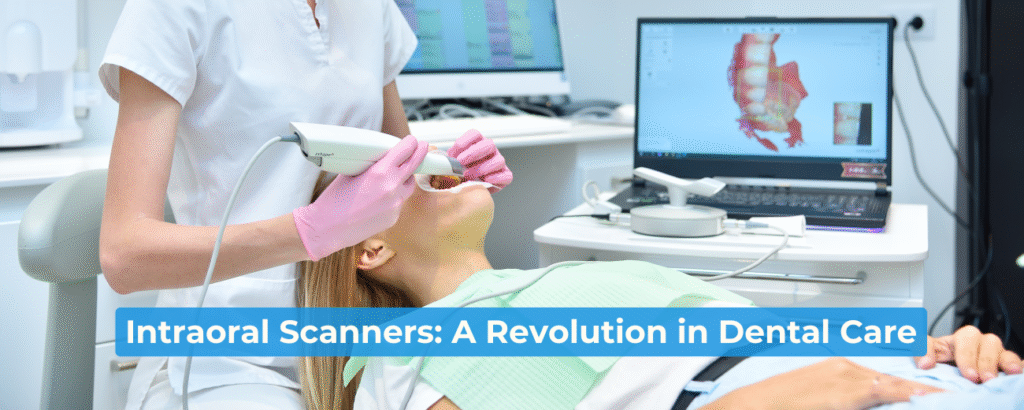
Remember the days of sitting in the dentist’s chair with a mouth full of gooey, uncomfortable impression material? For many, this messy and gag-inducing experience was one of the most dreaded parts of a dental visit.
Thanks to modern technology, those days are quickly becoming a thing of the past. Enter the intraoral scanner, a cutting-edge device that is transforming the patient experience and setting a new standard for precision in dentistry.
What is an Intraoral Scanner?
An intraoral scanner is a small, handheld wand that a dentist uses to capture a detailed, 3D digital image of a patient’s teeth and gums. Instead of a physical impression, the scanner takes thousands of high-resolution photos per second as the dentist moves the wand around the inside of the mouth. These images are instantly stitched together by specialized software to create a perfect, highly accurate digital model.
This technology is a cornerstone of digital dentistry, moving the entire process from a messy physical workflow to a streamlined, clean, and incredibly precise digital one.
How are Intraoral Scanners Useful?
The benefits of intraoral scanners extend to both the patient and the dental professional, offering a new level of comfort, accuracy, and efficiency.
1. Unmatched Comfort and Experience
This is perhaps the most significant benefit for patients. The process is completely comfortable, with no impression material and no gag reflex. The scan is quick, often taking just a few minutes, making the experience far more pleasant for everyone involved.
2. Superior Accuracy
Digital scans are far more precise than traditional impressions. This superior accuracy is critical for treatments that require a perfect fit. A highly accurate scan leads to better-fitting crowns, veneers, bridges, and clear aligners, resulting in fewer appointments for adjustments and a more satisfactory final result.
3. Speed and Efficiency
The moment the scan is complete, the digital file is ready. This file can be sent instantly to a dental lab, saving days in turnaround time compared to shipping physical impressions. The entire treatment process, from diagnosis to final restoration, can be significantly expedited.
4. Improved Patient Communication
Seeing is believing. With an intraoral scanner, patients can view their own teeth in real-time on a monitor. The 3D model enables the dentist to clearly explain a diagnosis, highlight areas of concern, and even simulate potential treatment outcomes, such as how the patient’s teeth will look after undergoing aligner treatment. This enhanced communication helps patients feel more informed and involved in their care.
5. Environmentally Friendly
The use of intraoral scanners significantly reduces waste by eliminating the need for messy impression materials, plastic trays, and the physical models used for lab work. It’s a cleaner, more sustainable process for dental practices.
Applications in Modern Dentistry
Intraoral scanners are useful for a wide range of procedures, including:
- Restorations: Creating perfect-fitting crowns, bridges, inlays, and onlays.
- Orthodontics: Planning and creating clear aligners, retainers, and braces.
- Prosthodontics: Designing and manufacturing dentures and implant-supported restorations.
- Diagnosis: Monitoring tooth wear and changes over time by comparing scans.
In conclusion, the intraoral scanner is more than just a piece of technology; it’s a game-changer that improves the patient experience while providing dentists with the precision they need for outstanding results. It represents the future of a more comfortable, efficient, and accurate dental care.